
课题组在国际期刊BOEG上发表论文
Deformation mechanism analysis of a complicated red-layer highway slope under the rainfall influence: a case study of the Niuchang slope in Yunnan, China
Suran Wanga,b, Jingyi Zhanga,*, Yu Huangc, Julia Kowalskid, Zhen Guoc, Shu Zhouc
aDepartment of Civil Engineering, University of Shanghai for Science and Technology, 516 Jungong Road, Shanghai 200093, China
bSchool of Intelligent Emergency Management, University of Shanghai for Science and Technology, 516 Jungong Road, Shanghai 200093, China
cKey Laboratory of Geotechnical and Underground Engineering of the Ministry of Education, Tongji University, Shanghai 200092, China
d Chair of Methods for Model-based Development in Computationa
Abstract
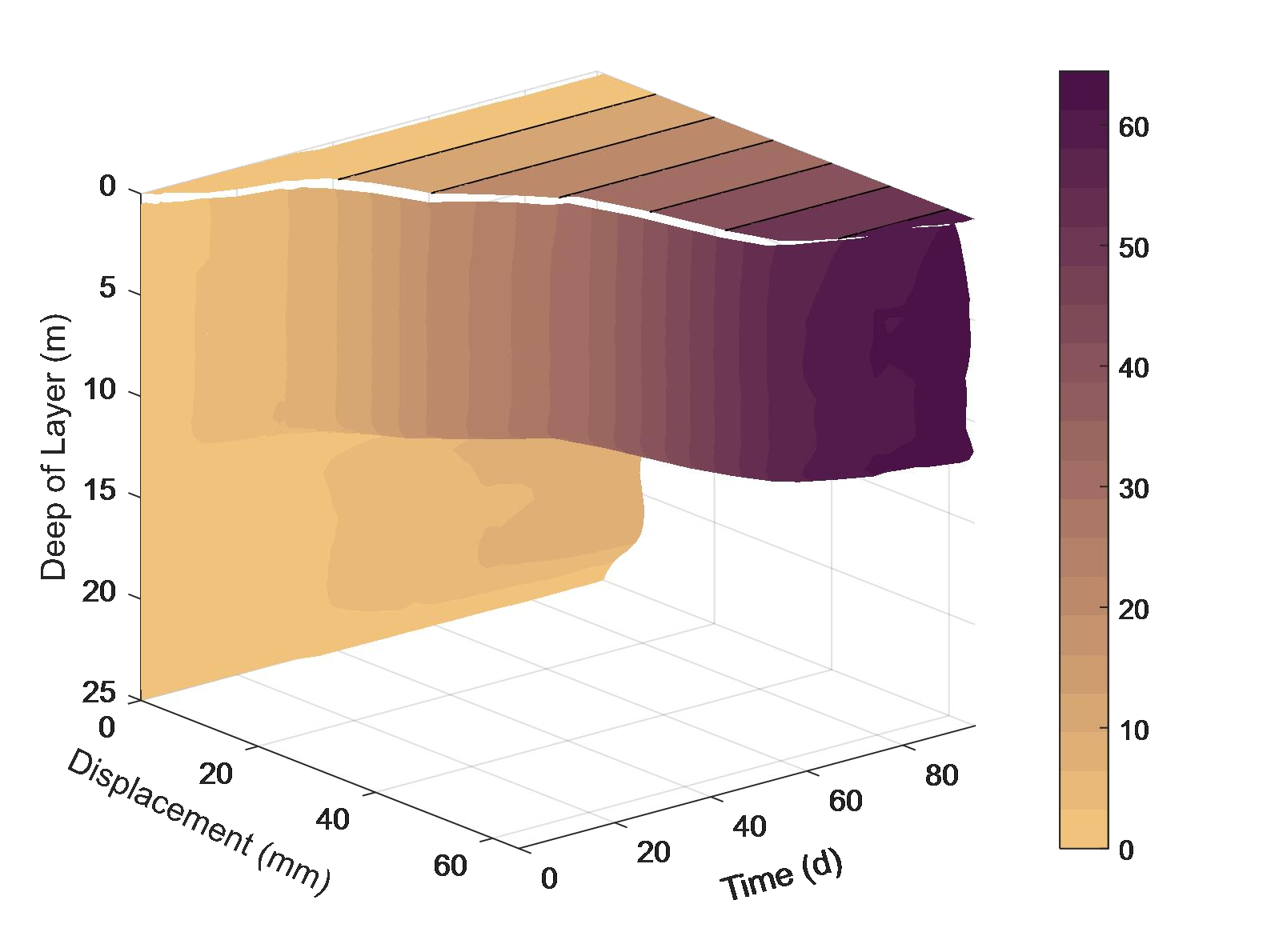
Rainfall is widely recognized as the dominant trigger of red-bed slope failures, yet most previous studies focus on slopes that have already experienced complete collapse. However, relatively few studies have investigated slopes undergoing progressive deformation without full failure, and potential threshold values for rainfall-induced weakening remain poorly constrained. This study analyzes the deformation mechanism of a red-bed highway slope in Niuchang Town, Zhenxiong County, Yunnan Province, China, through field monitoring, laboratory ring shear tests, and time-series comparison of rainfall and displacement. Inclinometer data revealed that displacement was mainly concentrated in the upper 10 m, consistent with ring shear test results showing more significant shear strength reduction at lower normal stresses (20-200 kPa, equivalent to 1-10 m depth). A time-series comparison between rainfall and surface displacement (0.5 m) further demonstrated their clear temporal correspondence, confirming rainfall infiltration as the dominant trigger of shallow deformation. Laboratory tests also showed that when water content reached about 30%, a marked drop in shear stress occurred, indicating a potential threshold for rainfall-induced instability. These findings provide quantitative evidence for rainfall-displacement interactions and highlight the critical role of wet-dry cycles in progressive weakening. The results not only improve understanding of red-bed slope instability mechanisms but also offer practical implications for slope stability assessment and drainage design in rainfall-prone regions.
Keywords: Red-bed slope instability, Rainfall-induced landslides, Shear strength reduction, Chlorite-montmorillonite minerals, Wet-dry cycles, Slope displacement monitoring
主要内容
本文针对中国云南省镇雄县牛场镇的红层公路边坡失稳问题进行了机制分析,旨在探讨降雨和土体性质对边坡稳定性的影响 。研究团队结合工程地质勘察与室内环剪试验,发现当地频繁的降雨导致边坡经历长期的干湿循环,地表松散的粉质粘土容易随水流堵塞排水管道,导致排水失效并使土体逐渐饱和 。实验数据显示,水分对土体的抗剪强度有关键影响,高含水率条件下土体的抗剪性能显著下降,且监测数据证实了浅层土体(特别是0-10米范围内)存在明显的水平位移和层状滑移现象 。研究结论指出,降雨引起的土体饱和以及排水系统的淤积堵塞是导致边坡失稳的主要原因,并据此建议通过改进和优化排水系统设计来缓解水分增加对边坡稳定性的威胁 。
创新点(伪)
揭示了特殊的致灾链条: 发现滑坡不仅仅是因为下雨,关键原因在于红层岩石风化产生的细小粉质粘土会堵塞排水系统,导致排水失效,从而使土体迅速饱和 。
实验方法的针对性: 采用了环剪试验模拟大变形过程,精准量化了这种红层土体在不同含水率(特别是过饱和状态)下的抗剪强度变化规律,验证了水是致灾的主控因素 。
纠正了设计盲区: 指出常规设计往往忽略了“开挖后泥岩会变成粘土并堵管”这一动态演变,强调了设计时需考虑粘土残余强度和防堵塞措施 。
引用格式
Wang, S., Zhang, J., Huang, Y. et al. Deformation mechanism analysis of a complicated red-layer highway slope under the rainfall influence: a case study of the Niuchang slope in Yunnan, China. Bull Eng Geol Environ 84, 548 (2025). https://doi.org/10.1007/s10064-025-04612-5